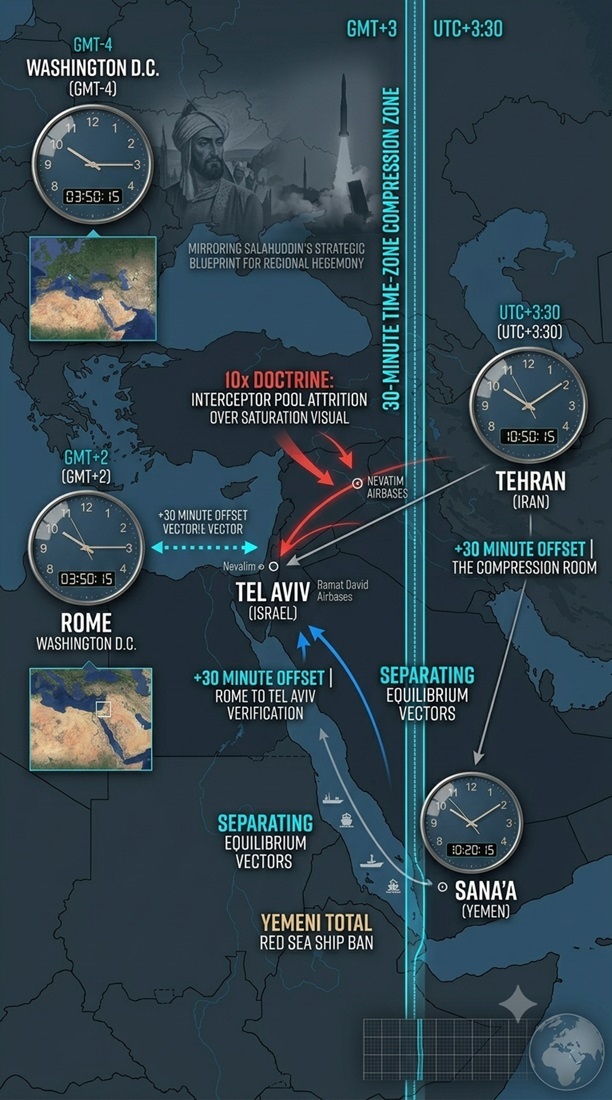
THE 10X RULE: INSIDE THE AXIS OF RESISTANCE AND ISRAEL’S 30-MINUTE SIGNALING GAME
Beyond the modern math of interceptor economics lies a calculated, high-stakes campaign to rewrite the rules of regional hegemony.
By Aveek Sen Ballalzai
Summary: While public attention remains fixated on the raw mechanics of missile strikes and airspace breaches, the true kinetic footprint of the conflict is driven by a brutal, invisible math. This is a clinical, asymmetric signaling game under incomplete information, designed by Washington and Tel Aviv to systematically strip Tehran of leverage and force the Islamic Republic into an absolute “Sub-optimal Bargaining” strategic capitulation. From Israel’s push for a separating equilibrium to the Axis of Resistance’s mathematically mandatory “10x saturation doctrine,” the current war is less about geography and more about exhausting the economic architecture of modern air defense. Yet, treating this purely as a 2026 missile crisis misses the foundational strategy underneath. Compressed within a single, 30-minute time-zone room, the Axis’s high-stakes kinetic escalation is a calculated defensive pivot to break this diplomatic siege—proving that Tehran’s regional architecture was always built to mirror the unifying strategic doctrines of Salahuddin’s historic campaigns, weaponizing regional depth to deny Western imposition and claim true sovereign hegemony.
Breaking from Yemen:
This conceptual framework aligns directly with real-time operational shifts in the theater. Following the latest high-velocity broadcast from Yemeni Armed Forces spokesperson Yahya Saree, primary tracking data confirmed a direct tactical missile strike targeting highly sensitive infrastructure targets across occupied Jaffa (Tel Aviv). This strategic insertion points to a deeply coordinated execution of the 10x saturation doctrine across the entire Axis of Resistance network, moving far beyond uncoordinated localized proxy friction.
The nominal ceasefire framework that has shakily quieted West Asia since early April did not just fracture over the last twenty-four hours—it buckled under the weight of unmediated structural realism. Following a chain of localized escalations, including an unannounced Israeli airstrike on the Mreijeh neighborhood of Beirut’s Dahiyeh suburbs, Iran’s Revolutionary Guards (IRGC) executed a sudden, direct ten-missile ballistic strike targeting northern Israel’s Ramat David Airbase. Within hours, the theater expanded into a borderless kinetic exchange, with Israeli air-launched ballistic missiles striking fifteen deep-theater infrastructure points across Tehran, Isfahan, Tabriz, and Karaj, closely followed by a morning long-range ballistic launch from Houthi-controlled Yemen targeting greater Tel Aviv.
While public attention remains fixated on the raw mechanics of missile strikes and airspace breaches, the true kinetic footprint of the conflict is driven by a brutal, invisible math. This is a clinical, asymmetric signaling game under incomplete information, designed by Washington and Tel Aviv to systematically impose asymmetric coercion on Tehran and force the Islamic Republic into an absolute sub-optimal bargaining scenario. From Israel’s push for a separating equilibrium to the Axis of Resistance’s mathematically mandatory “10x saturation doctrine,” the current war is less about geography and more about exhausting the economic architecture of modern air defense.
Yet, treating this purely as a 2026 missile crisis misses the foundational strategy underneath. Compressed within a single, 30-minute time-zone room, the Axis’s high-stakes kinetic escalation is a calculated defensive pivot to break this diplomatic siege. It proves that Tehran’s regional architecture was always built to mirror the unifying strategic doctrines of Salahuddin’s historic campaigns, weaponizing regional depth to deny Western imposition and claim true sovereign hegemony.
1. The Signaling Loop and Type-Casting
Under a classical game-theoretic framework with incomplete information, Israel and Iran operate as competing senders targeting an uninformed or evaluating receiver—in this case, the U.S. administration. Israel’s deep-penetration campaigns inside Lebanon and Iran are a calculated effort to force a “separating equilibrium.” By consistently demonstrating its ability to strike high-value assets with tactical impunity while neutralizing incoming threats, the Israeli security cabinet aims to prove to Washington that Iran is structurally weak.
The objective is to brand Tehran as a regional paper tiger—a “beggar with few missiles”—thereby stripping Iran of its leverage in the ongoing backchannel diplomatic tracks mediated via Islamabad. If Washington updates its beliefs to view Iran as severely degraded, its rational move is to demand absolute, unconditional concessions.
Conversely, Iran’s immediate execution of a 10x volume multiplier is a structural necessity to shatter that Israeli narrative. If Iran acts with conservative, proportional deference, it risks confirming Israel’s hypothesis to U.S. observers and losing its self-styled leadership over the broader regional Ummah. By launching an immediate, high-volume ballistic barrage, Tehran signals that its deterrent spine is intact. The scale of the response is deliberately calculated to push the U.S. belief system back into a pooling equilibrium, indicating that a weakened state could never afford to sustain such a costly kinetic output.
2. The Physics of Saturation and the Cost-Exchange Asymmetry
This 10x volume baseline is not an emotional overreaction; it is dictated by the mathematics of aerial defense saturation and strict resource economics. When a single combatant operates a highly sophisticated, multi-tiered air defense shield—such as Israel’s Arrow, David’s Sling, and Iron Dome arrays—the filter efficiency against low-volume inputs approaches near-perfection. If Iran fires a 1x defensive vector, the probability of complete interception is high, reducing the strike’s physical output to background noise and confirming the “weak type” narrative to outside analysts. To break this filter, the attacking actor must deploy volume to introduce mathematical entropy into the defensive allocation algorithms.
But the deeper, hidden vulnerability lies in the severe economic cost-exchange penalty imposed on the defender:
Defense Cost Layer = (Incoming Missile Volume × Firing Doctrine Constant) × Interceptor Unit Cost
When an Intermediate-Range Ballistic Missile (IRBM) costing roughly $100,000 to $300,000 to manufacture is engaged by an Arrow-3 interceptor carrying a price tag of $2,000,000 to $3,000,000, the economic balance tilts dramatically. Operating under a standard two-shot doctrine to guarantee detection and kill probabilities, a single incoming Iranian target drains $4,000,000 to $6,000,000 from the defensive treasury.
The Structural Balance Sheet:
- Attacking Vector Cost (IRBM): ~$100,000 – $300,000 | Defending Interceptor Cost (Arrow-3): ~$2,000,000 – $3,000,000 | Structural Exchange Ratio: ~10x to 20x Cost Penalty
- Attacking Vector Cost (Heavy Rocket): ~$20,000 – $50,000 | Defending Interceptor Cost (David’s Sling Stunner): ~$1,000,000 | Structural Exchange Ratio: ~20x to 50x Cost Penalty
Through the lens of resource economics, a complete aerial interception can still register as a major strategic loss. If Iran launches a small, mass-produced flight of missiles and every single one is shot down, Iran has effectively deleted tens of millions of dollars in highly specialized, slow-to-manufacture defensive inventory from its adversary’s reserves in a matter of minutes.
3. The Exhaustion of the Filter
This dynamic is particularly critical on Day 100 of the wider regional theater that ignited on February 28. Months of high-velocity attrition have systematically run down stockpiles of top-tier Western-backed interceptors. With the IDF forced to enact stringent inventory conservation protocols—increasingly modifying mid-tier David’s Sling or lower-tier Iron Dome parameters to stretch and catch heavy ballistic threats—the system’s baseline error rate shifts.
By applying a strict 10x volume rule, the Axis of Resistance shifts the Signal Detection Theory (SDT) matrix. They accept the reality that 90% of their vectors will be successfully filtered out as long as the remaining 10% leaks through to score a visible, unignorable kinetic hit.
This explains the profound anxiety vibrating through Washington. As President Trump noted in interviews today, the White House is increasingly intent on asserting its own veto over the pace of Israeli counter-strikes, declaring that Washington will ultimately “call the shots.” The U.S. administration recognizes what the pure tactical data proves: in a borderless war of attrition governed by a 10x volume reality, a high interception rate on the radar screen can mask an unsustainable, compounding bankruptcy on the balance sheet.