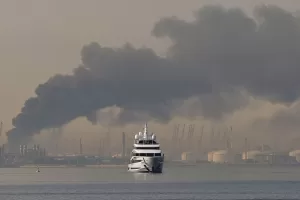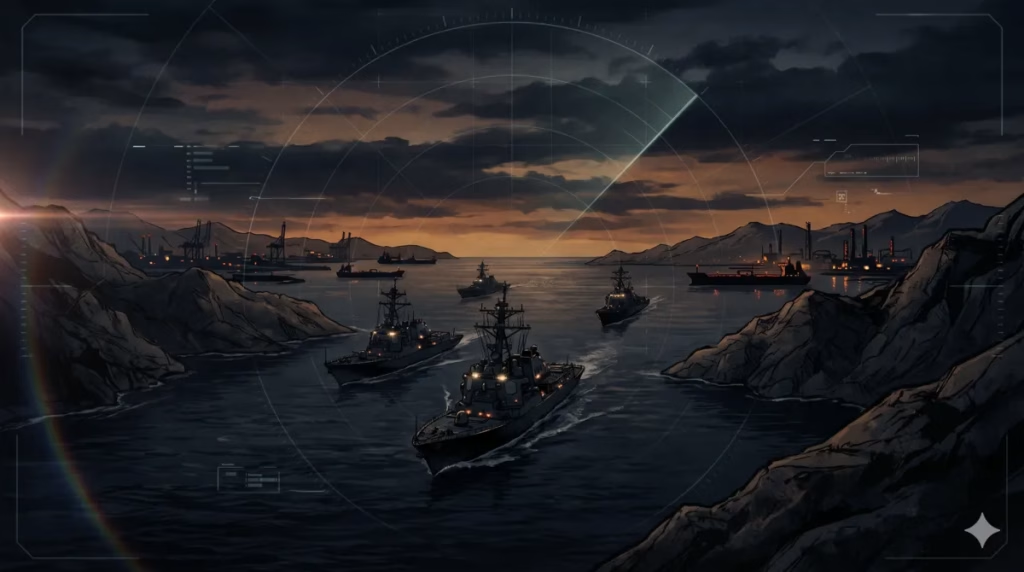
A fast-moving diplomatic, military, and macroeconomic campaign unfolded between October 29 and November 5, 2026, fundamentally altering the balance of power across West Asia. What began as an American effort to engineer pre-midterm crude oil relief through backchannel signaling collapsed into a coordinated defeat: the historic loss of the Republican congressional majority in Washington, the grounding of US tactical reconnaissance over the Persian Gulf, and the military exhaustion of the Saudi coalition in Yemen. By identifying Washington’s depleted strategic petroleum reserves as an inflexible operational deadline, Tehran and its regional allies locked the maritime choke points, broke coalition cohesion, and forced both the United States and Saudi Arabia to confront the limits of standoff deterrence.
Chronological Event Timeline: October 29 – November 5, 2026
-
October 29–30: Macroeconomic Depletion and the Vance Letter
- The United States awarded its final 41-million-barrel allocation under the collective IEA emergency drawdown, reducing the Strategic Petroleum Reserve (SPR) to a 44-year low of 283 million barrels. Severe salt-cavern creep at Bryan Mound and West Hackberry imposed hard geological ceilings on daily withdrawal rates, stripping Washington of its domestic price buffer ahead of the midterms.
- US Vice President JD Vance transmitted an official letter via Qatari channels to Iran’s Supreme National Security Council (SNSC) Secretary Mohsen Rezaei, seeking an off-ramp. Western outlets immediately leaked claims of direct US-Iran talks in Doha.
- Tasnim News Agency published an official wire denial within twelve minutes, confirming the Iranian delegation was in Qatar strictly for bilateral consultations and executing a costly rejection of Washington’s attempt to jawbone crude oil prices.
-
October 31: The Tehran Quadrilateral Summit and Supreme Leader Decrees
- Saudi Defense Minister Prince Khalid bin Salman, Turkish intelligence chief İbrahim Kalın, and Pakistani defense officials arrived in Tehran for an unannounced quadrilateral meeting. Prince Khalid bin Salman privately stated to Mohsen Rezaei that after Iran, Israel’s expansionist apparatus would target Turkey and then Saudi Arabia, leading Riyadh to omit the Mecca Pact and Yemen from the agenda.
- Supreme Leader Ayatollah Seyed Mojtaba Khamenei convened the Armed Forces High Command, establishing three binding directives: retaliation “without geographical limitation,” expanding target banks to include “immaterial assets” (C4ISR, cyber links, datalinks, P&I maritime insurance registries), and declaring Iran alone will dictate war termination terms.
- Mohsen Rezaei announced on national television that Washington’s tone had softened, established seven non-negotiable conditions to reopen the Strait of Hormuz, and disclosed rising domestic demands to revise the defensive nuclear doctrine.
-
November 1: UK Proscription, Standoff Sanctuary Denied, and the Ashgabat Snub
- Iran designated the UK Royal Navy and RAF as terrorist organizations and MI6 as a hostile group, stripping British assets of peacetime UNCLOS protections and pre-authorizing strikes on rear staging nodes like RAF Akrotiri and Diego Garcia.
- Operationalizing Vahdat-e Sahat (Unity of Arenas), Tehran authorized strikes against British escorts in the Arabian Sea, breaking the maritime interdiction net hunting Yemeni logistics and closing the southern bypass corridor.
- Foreign Minister Abbas Araghchi traveled to Turkmenistan to review Eurasian rail and gas transit, demonstrating strategic patience while Washington’s pre-election clock ran out.
-
November 2: The “Final Scene” Demonstration and Air Defense Vulnerability
- Majlis National Security Chairman Ebrahim Azizi released verified Operation True Promise 2 footage captioned “The real Halloween… Wait for the final scene,” documenting hypersonic warheads bypassing Arrow-3 exo-atmospheric envelopes, direct cratering 800 meters from the Glilot intelligence base (Unit 8200/Mossad HQ), and urban saturation across the Gush Dan corridor.
- Technical evaluations highlighted the kinetic failure of hit-to-kill architectures (THAAD, Patriot PAC-3 MSE) against maneuvering reentry vehicles (MaRVs), sector-limited radar blindness (90° tracking arcs), and US interceptor production limits (~80 THAAD missiles per year).
- Majlis committee spokesman Hassan Ghashghavi formally stated that attacks on inspected sites made an istifta-ye jadid (a new fatwa on nuclear weaponization) inevitable.
- MFA Spokesperson Esmaeil Baqaei issued an absolute “No” to shipping the 60% enriched uranium stockpile abroad, reaffirmed Mohammad Bagher Ghalibaf as Chief Negotiator, and locked Hormuz to dismantling the naval blockade.
- Sultan Haitham of Oman arrived in Beijing for a state visit with Xi Jinping, joining prior Saudi defense missions to anchor Gulf security in Chinese strategic partnerships.
-
November 3: US Election Day Blinding and Rejection
- 02:20 AM: The IRGC destroyed the 55th US MQ-9 Reaper over Hormuz and used electronic warfare to ground two US MQM-170 reconnaissance drones intact over Qeshm Island.
- 11:36 AM: Araghchi on Al Jazeera decoupled the GCC monarchies from Western forces, assuring Gulf neighbors that Iranian pressure targets foreign expeditionary forces.
- ~1:15 PM: Ghalibaf warned from the Majlis that any US miscalculation would face an unpredictable strategic response.
- ~5:15 PM: Deputy Foreign Minister Kazem Gharibabadi stated that the UNGA New York draft remains the baseline and declared Iran indifferent to the US midterm results.
- 07:54 PM: Mohsen Rezaei publicly rejected Washington’s counter-offer as “not convincing,” keeping the Strait of Hormuz closed.
- ~08:10 PM: Coastal air defense batteries at Bandar Khamir intercepted two US LUCAS kamikaze drones (reverse-engineered copies of the Shahed-136).
-
November 4–5: Washington Midterm Defeat and Saudi Capitulation
- The US midterms concluded in a historic Democratic sweep, flipping Senate seats in South Carolina, Texas, Kansas, Maine, and Iowa, yielding a 55-seat Senate majority and a 255-seat House majority.
- Speaking to The Wall Street Journal and Fox News, Donald Trump admitted that the war in Iran and resulting gasoline spikes were partially to blame for the sweeping Republican defeat, prompting Ghalibaf to state Americans said “NO TO WAR,” while Rezaei noted Trump was handed a military defeat in Hormuz and a political defeat in Washington.
- Yahya Saree announced a precision ballistic missile strike on King Khalid International Airport in Riyadh, damaging infrastructure and declaring Saudi airspace unsafe. AnsarAllah launched multi-axis barrages hitting troop mobilizations east of Al-Jawf and Lahij, drone strikes on the Al-Qahmah coastal radar, missile strikes on the Aakefah camp and Jizan Border Guard C2, and shot down their 10th Saudi Wing Loong II drone over Taiz.
- The Wall Street Journal revealed that Saudi Arabia approached AnsarAllah (derogatorily called the Houthis) to ask what it takes to make peace, confronting demands of lifting naval & air blockade and $51 billion in war reparations.
- Ayatollah Mojtaba Khamenei declared on 13 Aban that sovereign control of Hormuz shattered the myth of American invincibility, while the IRGC downed the 15th US MQ-1 drone over Qeshm Island.
Strategic and Tactical Dissection
The collapse of the allied posture stems directly from the failure of standoff air defense and intelligence assets. The systematic downing of 55 MQ-9s, 15 MQ-1s, and 10 Wing Loong II platforms eliminated the persistent medium-altitude reconnaissance necessary to track mobile transporter-erector-launchers (TELs). CENTCOM was forced into active radar emissions, exposing its own batteries to coastal counter-fire.
———————————————————————————
NORTHERN FLANK: IRAN (Hormuz) | SOUTHERN FLANK: ANSARALLAH (Bab el-Mandeb)
– 55 MQ-9s & 15 MQ-1s downed | • Riyadh Airport ballistically struck
– UK Navy & RAF designated terrorists | • 10th Wing Loong II shot down
– 60% uranium stockpile retained | • 104 Saudi air sorties fail
– Hormuz locked to 7 conditions | • Saudi Arabia sues for peace
At the terminal tier, Operation True Promise 2 confirmed that multi-layered air defenses cannot defeat hypersonic salvos. Kinetic hit-to-kill interceptors require physical impact, yet terminal maneuvering reentry vehicles pull lateral Gs that outpace the translation rate of divert and attitude control systems (DACS). Against simultaneous salvos, standard AN/MPQ-65 Patriot radars saturate their 90° tracking sectors, magazine depths empty in minutes, and crane reloads require up to two hours per launcher.
In Yemen, Saudi Arabia’s air campaign proved incapable of suppressing mobile missile infrastructure, despite flying 104 sorties in 24 hours and over 4,136 strikes across the wider escalation. Direct ballistic impacts on King Khalid International Airport exposed the vulnerability of Saudi civil aviation and Vision 2030 hubs. Approaching the Houthis for peace confirms that Riyadh cannot bear the cost of prolonged infrastructure strikes. Crucially, AnsarAllah’s demand for permanent sovereign recognition explicitly rejects transitional electoral sunset clauses. Rooted in the Wilayah governance model, AnsarAllah treats supreme sovereign authority as non-negotiable, permanently superseding the Riyadh-backed Presidential Leadership Council and securing absolute control over northern Yemen.
Game-Theoretic and Signal Detection Modeling
The entire campaign illustrates James D. Morrow’s models of crisis bargaining under incomplete information and dynamic commitment. Washington operated under severe time-inconsistency: facing a depleted SPR, the administration attempted to purchase crude market stability before the election while reserving the option to escalate afterward. Tehran defeated this dynamic by rejecting partial compromises:
$$U_{\text{Tehran}}(\text{Partial Concessions}) = 0 \quad \text{vs.} \quad U_{\text{Tehran}}(\text{Full Seven Conditions}) > 0$$
By conditioning the reopening of the Strait of Hormuz on the complete lifting of the naval blockade and rejecting the transfer of its 60% enriched uranium stockpile, Tehran transformed negotiations into an indivisible package. Trump’s admission to The Wall Street Journal confirms that Washington exceeded its war termination threshold (\(T^*\)), as domestic audience costs (\(c_{\text{audience}}\)) translated into an electoral wipeout. Simultaneously, the inversion of Saudi Arabia’s utility function prompted direct bilateral appeals to Sana’a, shattering the coalition’s external balancing strategy.
Under Macmillan & Creelman’s Signal Detection Theory (SDT), coalition communication relied on sensor noise (\(N\)) to project air-defense invulnerability. Verified missile impacts on the Glilot base and King Khalid International Airport collapsed the noise floor, driving signal sensitivity upward (\(d’ \gg 0\)):
$$d’ = \frac{\mu_{\text{Direct Impacts on Capital Infrastructure}} – \mu_{\text{Air Defense Interception Claims}}}{\sigma} \gg 0$$
Because the operational cost of a defensive failure (\(C(\text{Miss})\))—such as closed international airports, destroyed command centers, or an altered nuclear fatwa—is catastrophic, decision-makers in Washington and Riyadh were forced into an ultra-conservative response criterion (\(c \gg 0\)). By enforcing this operational reality from the Strait of Hormuz to the Bab el-Mandeb, Tehran and Sana’a have dismantled Western standoff deterrence, establishing that regional security cannot be dictated by foreign expeditionary forces.